


You walk into the room thinking bingo night is simple. A caller reads numbers, players mark cards, somebody shouts “Bingo,” and a prize gets handed over. Then the host announces a special pattern, the regulars start asking about bonus cards, and you realize the night has more moving parts than it looked like from the doorway.
That's why bingo night rules matter. The core game is easy, but the details change fast once a bar, fundraiser, or community venue layers in house rules, prize limits, pacing decisions, and local compliance. The trick is knowing what never changes, what a host can customize, and when a casual game becomes a regulated event.
Table of Contents
- What Every Bingo Night Actually Involves
- Core Vocabulary and Equipment for Bingo Night
- Standard Bingo Card Formats Around the World
- How a Standard Bingo Game Is Played
- Common House Rules at Bar Bingo Nights
- Caller Scripts, Pacing, and Running a Smooth Game
- Payouts, Prize Caps, and When Bingo Becomes Regulated
- Handling Common Bingo Disputes and Rule Conflicts
- Running Bingo Around Food, Drinks, and Late-Night Service
- Quick Reference and Bingo Night FAQs
What Every Bingo Night Actually Involves
A good bingo night has a simple spine. The host sets the pattern, the caller draws numbers, players mark cards, and the room stops when someone completes the announced win condition. The exact flavor changes from venue to venue, but those moving parts stay the same whether you're in a neighborhood bar or a larger scheduled event.
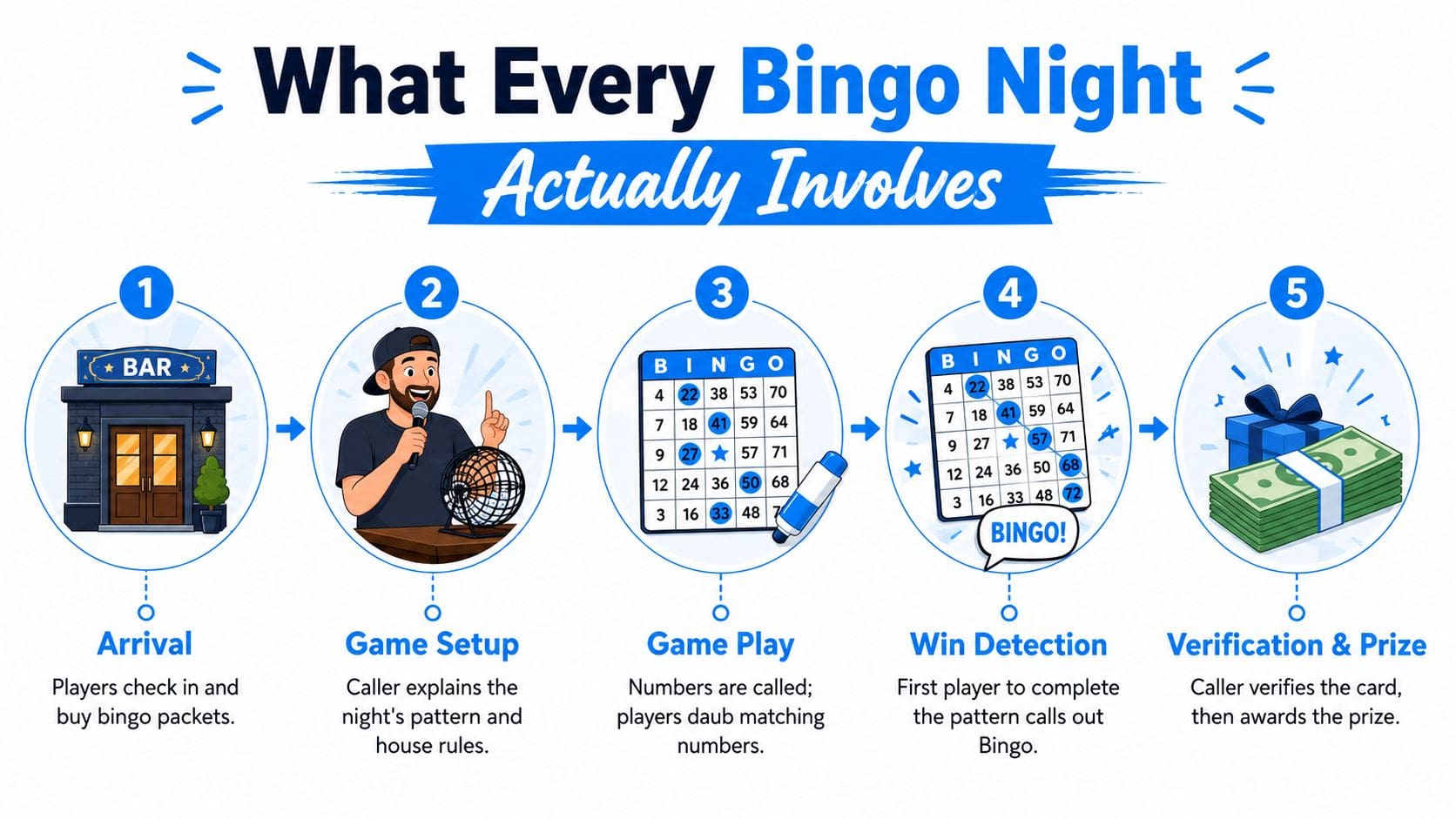
If you're walking into a Saturday-night game, the flow is usually steady: check in, buy packets, get the house rules, settle in, then listen for the pattern before the first number is called. If you're hosting, the same sequence is your operating map. Miss one of those steps and the room starts asking questions before the first round is even done.
The clearest way to think about the night is as a sequence of checks. The caller keeps the pace, the players keep their cards visible and marked, and the staff handles verification before any prize changes hands. A solid pre-event plan helps, which is why a practical free event planning checklist from ABC Hire can be useful when you're getting a first event organized.
Practical rule: the room runs smoother when the caller explains the pattern before the game starts, not after someone thinks they've won.
Hosts who want to see a live-event version of this structure can also compare notes with The Banana Factory's bingo night live event page, which sits in the same broad category of venue-run bingo programming. The key point is simple, the game is social, but it still needs structure.
Core Vocabulary and Equipment for Bingo Night
Every bingo night gets easier once the room uses the same words. A card is the sheet or ticket with the numbers printed on it. A face is one individual board on a packet, while a packet is the full set a player buys for the session. The free space is the square that counts automatically, and the pattern is the shape or line the player has to complete to win.
The rest of the language is operational. The caller announces numbers, the dauber marks them, and the win claim happens when a player says they've completed the announced pattern. Verification is the check that confirms the claim before the prize goes out. If a venue uses chips, electronic interfaces, or digital displays, those tools change the workflow, but they don't change the need for clear calling and clear proof.
What the basic equipment usually includes
- Caller machine or cage: A physical draw system or approved random number method.
- Balls or RNG system: The source of the number sequence, depending on format.
- Printed cards or packets: The player's ticket to the session.
- Daubers or chips: The marking method the venue allows.
- Projector or display: Helpful for larger rooms and noisy bars.
- Sound system: Necessary when the room has music, food service, or crowd noise.
The fastest way to create conflict is to let people improvise their own marking method. Pens, highlighters, and half-legible scribbles make verification messy. If the venue hands out daubers, that's because uniform marking saves time and avoids arguments.
If the house supplies the equipment, use the house equipment. The more the room standardizes, the less time the caller spends settling avoidable disputes.
Think of the terminology as the contract between the host and the room. When players know what counts as a face, what counts as a pattern, and what counts as a valid claim, the night feels fair even before the first prize is announced.
Standard Bingo Card Formats Around the World
The two formats most commonly encountered in major markets are 75-ball bingo and 90-ball bingo. In the U.S., the standard card is a 5×5 grid with 25 spaces and a free center space. The number range runs from 1 to 75, split across the B-I-N-G-O columns, which is why the caller's wording matters so much in American-style games. Those basics sit inside a long history, from Le Lotto in 1778 to standardization in the early 1920s and a published rule book in 1933 by Hugh J. Ward in the Pittsburgh area, as described in the historical record on Bingo).
In the U.K. and much of Europe, 90-ball tickets look different on purpose. They use 3 rows and 9 columns, with 5 numbers and 4 blanks in each row, and the usual wins are one line, two lines, or a full house. That format is built for a different pace and a different rhythm, which is why a 90-ball game can feel more like a paced session than a fast mark-and-yell round.
Side-by-side format comparison
| Format | Card shape | Number range | Common wins |
|---|---|---|---|
| 75-ball | 5×5 with a free center space | 1 to 75 | Letter patterns, blackout, coverall, and venue-specific shapes |
| 90-ball | 3 rows, 9 columns | 1 to 90 | One line, two lines, full house |
The winning pattern matters more than the card art. A blackout or coverall asks for every number on the card, while a T, X, L, or postage stamp can turn a simple round into a themed one. The caller should announce the win condition before play starts, because a player who thinks they're chasing one line is going to react very differently from a player who knows the room is running a full-card game.
That scale is part of what made bingo durable. More than 1.5 billion bingo cards are printed each year, and a recorded game in Bogotá in 2006 drew over 70,000 players, according to the industry history linked above. Those numbers show why the formats are so standardized, venues can plug into a familiar structure without redesigning the game from scratch.
How a Standard Bingo Game Is Played
The standard loop never changes much. The caller draws a number, says it clearly, and players mark it if it appears on their card. In a 75-ball game, the announcement usually follows the letter-number format tied to the column, so a number gets called as something like B-12, I-23, N-33, G-52, or O-68.
The call-and-mark rhythm
The game stays fair when the room gives each number enough breathing space. A practical host guide recommends 10 to 15 seconds between calls for standard games, with an immediate stop-and-check when someone calls “Bingo,” and New York's gaming guidance says wins are reviewed before a prize is issued and the next game begins, according to how to host a bingo night.
That pause isn't just ceremony. It gives players time to mark accurately, it gives the caller time to keep the board or master sheet clean, and it prevents the room from racing ahead of the verification process. Once a claim comes in, play stops until the staff checks the card against the called sequence.
A valid bingo claim is never a vibe check. It's a number check.
If the claim doesn't match the announced pattern, the call is invalid. Common failures are simple, the player chased the wrong pattern, missed a number, or called too late after the next ball already came out. A careful caller will say the winning pattern aloud, verify the card, and then move on without letting the room spiral into debate.
The strongest habit for hosts is to make the verification step visible. When players can see the check happen, they trust the result even if they didn't win.
Common House Rules at Bar Bingo Nights
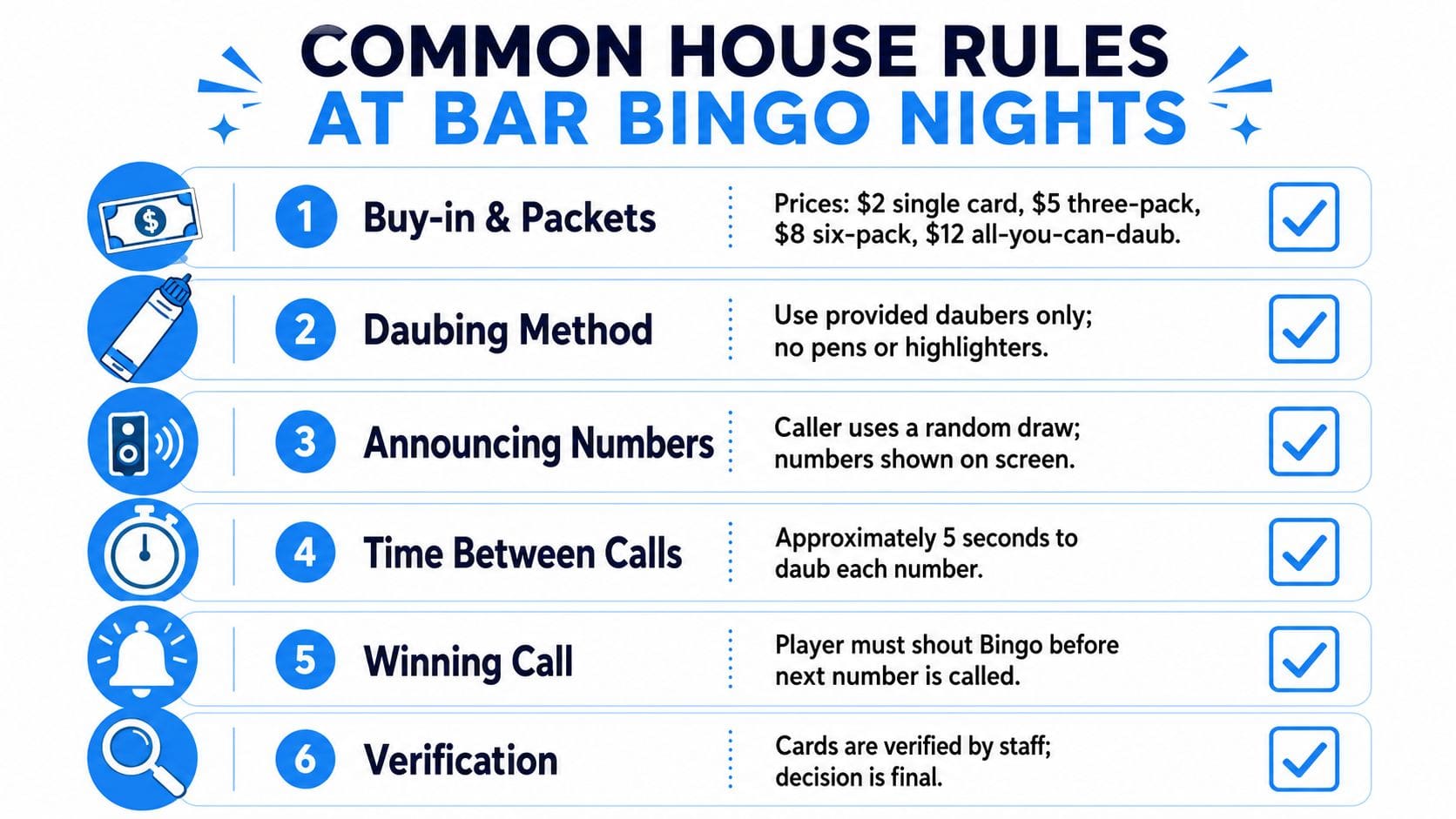
A bar bingo night usually starts as a simple game and then picks up the venue's own rules. The house decides how packets are sold, how many rounds run before a break, which bonus games appear, and whether a special pattern pays more than a regular line. One room may stay close to a single packet and a few line games, while another adds themed rounds, progressive jackpots, and shout-out prizes for birthdays or groups.
The rules most bars customize
- Buy-in and packets: The venue sets the packet structure and price.
- Special-pattern rounds: A night may switch from lines to shapes, corners, or blackout.
- Bonus cards: A host can add a free extra card for a bundle purchase.
- Progressive pots: A rollover prize can carry forward if no one wins.
- Wild or double-daub specials: Some venues mark a designated number or let one round count extra.
- Theme nights: Holidays, drag events, and costume games often use custom round rules.
The practical work is in the repetition. A host can copy the same packet format every week, or build in small variations for a crowd that wants a little more movement. The rule set should be clear enough for a first-time player, but flexible enough for a regular room that wants novelty without confusion. For venues sketching out bar bingo night ideas, that balance usually matters more than adding another prize tier.
Consistency still matters more than clever extras. A strong set of key standard operating procedures from OrderOut helps a bar lock down repeatable front-of-house behavior, and bingo benefits from the same discipline. Players will accept a playful format. They will not be patient when the rules change halfway through the session or when one table hears a different version than the rest of the room.
The core question is whether the room can follow the extras in real time. If the answer is no, the house should strip the packet back and save the novelty for another night. That is where a casual game starts to touch regulated gaming concerns, because the cleaner and more formal the prize structure becomes, the more important it is to keep the rules visible, stable, and easy to verify. A good host reads the room, keeps the base game familiar, and only adds the kind of extras the players can repeat back without guessing.
For a weekly roster, the house rules should be easy to see on a screen or printed sheet, not buried in a chat thread. If a player cannot explain the round back in one sentence, the rule is probably too clever for a live room.
Caller Scripts, Pacing, and Running a Smooth Game
A caller doesn't need a stage voice as much as a steady one. The best script is plain and repeatable, something like, “B-12, the lucky number is B-12,” followed by the next number only after the room has had time to mark. Repeating the call once is useful, especially in a loud bar, because players who are talking, drinking, or laughing will still need a clean second pass.
Pacing that keeps the room with you
Standard games work best when the room has enough breathing room to mark cards and order drinks. Speed rounds need a tighter pace, but they're a choice, not a default. Operator guidance aimed at hosts recommends 8 to 10 seconds between calls for standard games, 5 to 7 seconds for speed rounds, no more than five games without a break, and at least one special-pattern game per hour, according to how to host the perfect bingo night.
That pacing advice lines up with what works in bars. Fast rooms can be fun, but too much speed punishes newer players and makes social groups feel like they're falling behind before they've settled in. A better night leaves room for the bar to sell food and drinks, lets regulars chat, and still preserves the tension of the draw.
Caller habits that prevent mistakes
- Announce the pattern first: Players need to know what win condition they're chasing.
- Repeat clearly: One call for the room, one repeat for the stragglers.
- Mark verified wins on a master sheet: It keeps the session organized.
- Don't speed up because of noise: Volume isn't a reason to rush the draw.
- Hold the pause after a claim: Verification comes before the next number.
I've seen rooms go sideways when a caller tries to outpace the crowd. The better move is to slow the room, not the script. A caller who sounds calm gives players confidence that the game is under control.
Payouts, Prize Caps, and When Bingo Becomes Regulated
Most bar bingo nights pay out in small ways. Cash prizes are common, but so are bar tabs, gift cards, drink vouchers, and prize baskets. Those formats work because they're easy to explain, easy to verify, and easy for a venue to absorb without turning the night into a licensing headache.
The line gets sharper when money, fundraising, or larger prize pools enter the picture. Rhode Island limits an organization to 45 games per occasion and caps total prizes at $7,500 per night, according to its bingo regulations. Alberta's commercial bingo rules require formal house rules and standard rules of play, while Ontario requires the winning pattern and prize amount to be announced immediately before each game and verified before payout, as set out in the regulatory guidance at Rhode Island regulations.
Bingo prize and session limits by jurisdiction
| Jurisdiction | Session or Game Limit | Prize or Spend Cap |
|---|---|---|
| Rhode Island | 45 games per occasion | $7,500 per night |
| Ontario | At least 2 consecutive hours or 20 games for bingo sessions, with special sessions needing a permit | C$3,000 per session unless specially approved |
| Los Angeles | No more than three days per week and one session per day | Local permit-based limits apply |
| UK fundraising bingo | Event limits apply by format, with special treatment for final-in-series events | £8 per person and £600 prize limits, with a higher final-event cap |
That table is the reason hosts need to check local law before they add a prize table. Ontario, Los Angeles, and the U.K. all show that “bingo” can mean very different compliance obligations depending on where the event runs. The useful mental rule is simple, the more the night looks like gaming, the more the venue should treat it like gaming.
For a casual bar host, the safest approach is to keep prizes modest, keep the rules visible, and keep the event clearly framed as entertainment unless local law says otherwise. Once buy-ins, cash pots, and fundraising language start stacking up, it's time to verify the local rules before the first packet is sold.
Handling Common Bingo Disputes and Rule Conflicts
Most disputes are not complicated. A player says they won on the wrong pattern, two people call at once, somebody realizes they marked the wrong square after play has moved on, or a late arrival asks to jump into the current round. The job of the host is to resolve it quickly and visibly without turning the room into a courtroom.
The cleanest way to handle the usual problems
- Wrong pattern claim: Check the announced win condition first, then inspect the card.
- Two winners at once: Freeze the draw, verify both claims, and honor the first valid call if the house rule says so.
- Mis-daubed card: If the next number has already been called, the claim usually stands or falls on the visible card at the moment of verification.
- Missed announcement: If the caller skipped a number, the master sheet should decide the sequence, not memory.
- Late arrival: The player usually joins the next round, not the current one.
- Refund demand after a loss: House rules should say whether packet sales are final.
The most important part is consistency. If the bar lets one player fix a mis-marked card after the room has moved on, then the next player will expect the same treatment. Fairness in bingo is not about making everyone happy, it's about applying the same standard to everyone in the room.
Keep the verification short, calm, and visible. The longer the room waits for a ruling, the more the noise level climbs.
A printed dispute checklist near the caller station helps. It should list the win pattern, the claim procedure, the verification step, and the rule for late or invalid claims. That way staff can answer from the sheet instead of improvising under pressure.
Running Bingo Around Food, Drinks, and Late-Night Service
A bingo night in a bar or restaurant works best when the room can keep eating, drinking, and playing without the service team losing control of the floor. Guests need time to order, kitchens need time to send food, and servers need enough room to move without blocking the sightline to the caller. The cleanest setups place the caller where the room can see and hear them, then add a screen or projector for number display if the space is loud or crowded.

Cadence matters more than flair. A room needs short breaks, not constant interruption, and those pauses work best when they are planned so food can move between rounds. Spill-resistant drinks and simple finger foods hold up better than complicated plates during a game, because players can keep one hand on a drink and the other free for marking without creating constant cleanup for staff.
A practical venue can also tie bingo into broader service without blurring the game's boundaries. A bar might run a happy-hour bingo slot, another might bundle food and packet sales, and a community venue might frame the whole evening as a social night with a game in the middle. For hosts looking at bar drink service tips, the useful lesson is the same, serve the room in a way that supports attention, pace, and clear calls. One venue option is The Banana Factory, which combines bar service, an on-site grill, and recurring bingo programming in Puerto Vallarta's Zona Romántica.
The room still needs structure even when the atmosphere is loose. Put one visual display where people can glance at it between sips, keep the caller audible over music, and leave enough time between games for servers to clear tables. Bingo feels spontaneous when the schedule is tight behind the scenes.
Service should support the game, not compete with it.
Quick Reference and Bingo Night FAQs
The short version is easy to remember. The center space is free in 75-ball play. Only the announced pattern wins the round. Winners must call out immediately, and verification is final once staff confirms the card. If the house runs special patterns, those override the casual assumptions players bring from home.

Quick FAQ
Can I play multiple cards?
Yes, if the house allows it and you can keep up with the pace. Multiple cards only help if you can mark them accurately.
Are electronic daubers allowed?
Only if the venue says so. Some rooms want standard daubers because they make verification cleaner.
What happens if no one wins a blackout?
The house rule controls that outcome. In some rooms the pot rolls over, in others the prize resets or the next round uses a different pattern.
Can late arrivals join right away?
Usually not. Most hosts seat late players for the next round to keep the current game fair.
Can I buy extra cards mid-game?
Usually no, because packets are sold before the round starts and mid-game sales create confusion.
If you host or play often, the safest habit is to check the pattern, confirm the packet rules, and never assume one bar's bingo night works like the next. The details are small, but they decide whether the room feels relaxed or chaotic.
If you want a bingo night with a clear game flow, good food, and a room that knows how to keep the energy up without losing the rules, visit The Banana Factory. It's a practical fit for guests who want a social night out with bingo, drinks, and late-night service in one place.
