

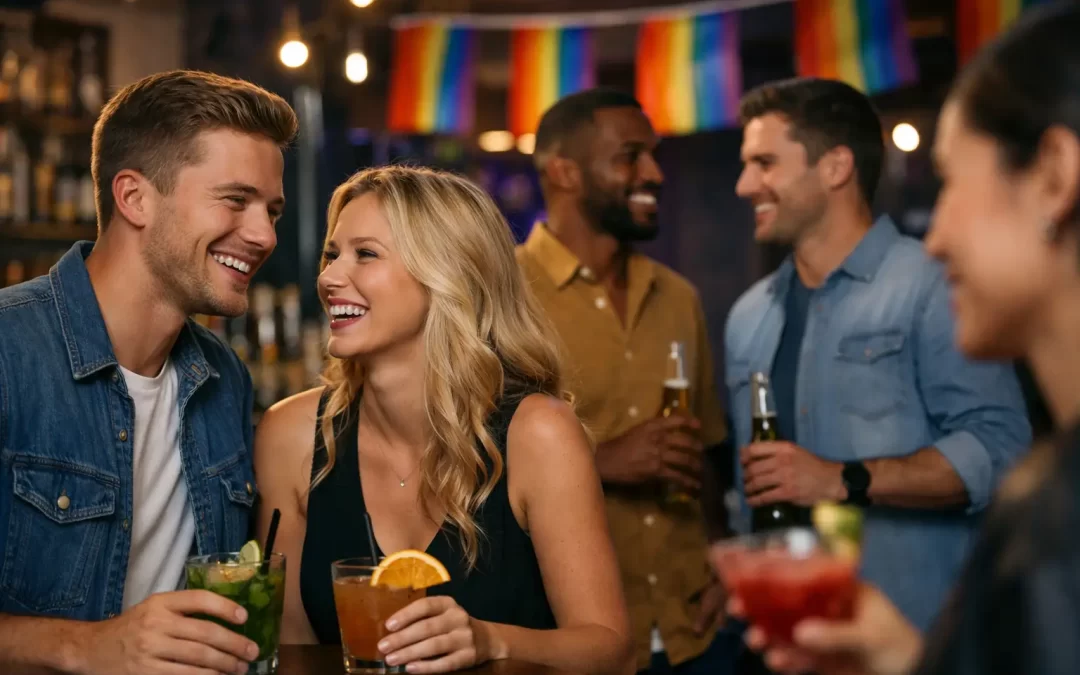
You’re in a new city, the music is loud, the crowd looks incredible, and you’re wondering: can allies go to gay bars? Yes – absolutely. But the better question is how to go in a way that adds to the energy instead of draining it.
Gay bars are not private clubs where allies are automatically unwelcome. They are, however, community spaces with history, purpose, and a vibe worth protecting. People go there to relax, flirt, dance, celebrate, and exist without the straight-world filter switched on. That means allies are usually welcome when they come with respect, good energy, and an understanding that the night is not centered on them.
Can allies go to gay bars without it being weird?
Yes, and most of the time it is not weird at all. Friends bring friends. Couples go out together. Travel groups mix. Locals and visitors bounce around different spots all night. A gay bar can be one of the most fun, friendly, high-energy places in any nightlife scene, and allies are often part of that mix.
What makes it weird is not being an ally. What makes it weird is treating the bar like a novelty stop, a joke, or a spectacle. If someone walks in acting like they are doing the room a favor by being open-minded, people feel that immediately. If they come in ready to enjoy the music, tip well, respect the crowd, and let LGBTQ+ guests take up space, they usually fit in just fine.
That difference matters. A bar can be open to everyone and still exist primarily for a specific community. Good allies understand both parts at once.
Why gay bars matter in the first place
This is where a lot of the confusion comes from. People hear “inclusive” and assume that means every space works exactly the same way. It doesn’t.
Gay bars have long been more than bars. They have been meeting places, dating spaces, dance floors, refuge, celebration, and sometimes the only room in town where people could fully be themselves. Even now, when acceptance is broader than it used to be in many places, that doesn’t mean LGBTQ+ people stopped needing spaces that feel easy, affirming, and theirs.
So yes, allies can join the party. But the history behind the party still matters. If you understand that, your behavior tends to fall into place naturally.
How to be a good ally in a gay bar
Start by dropping the tourist mentality. This is the biggest one. If you are there to gawk, comment on how “wild” everything is, or treat other guests like entertainment, you are already off track.
A good ally shows up like a good guest anywhere else. Be friendly. Be normal. Be respectful. If someone flirts with you and you’re not interested, decline kindly and move on. No one needs a dramatic speech about your orientation. A simple “I’m flattered, but no thanks” works.
It also helps to read the room. Some gay bars are mixed and social in a broad, open way. Others are more cruisy, more community-centered, more performance-driven, or more packed with regulars who know exactly why they came. There is no single script for all of them. The right move is to pay attention before trying to steer the vibe.
If the energy is playful and flirty, don’t act shocked by flirtation. If there’s a drag show, don’t talk over it. If the crowd is there to dance, don’t plant your group in the middle of the floor like you’re at a private table-service club. The room usually tells you what it needs.
Can straight women and straight men both go?
Yes, but the social impact can feel different depending on the group and the behavior.
Straight women are often welcomed in gay bars, especially when they’re genuinely part of the community mix. But there is also a point where a venue can start feeling overrun by bachelorette energy, loud outsider behavior, or groups treating gay men as accessories. That can change the atmosphere fast.
Straight men can absolutely go too, especially with friends or partners, but they need to leave defensiveness at the door. In a gay bar, being approached by men is not a crisis. If that possibility makes someone angry or aggressive, that person should pick another venue.
So the answer is yes for both. The condition is simple: don’t make your comfort the center of the room.
The biggest mistakes allies make
The first mistake is assuming welcome means ownership. You can be invited into a space without that space becoming yours to redefine.
The second is overreacting to attention. If you’re in a flirt-friendly nightlife spot, people may flirt. That is not disrespect. It is often just nightlife. Handle it with the same ease you’d want from others.
The third is turning the bar into a straight-group destination. This happens when big groups of allies flood a venue because they think it feels more fun, less macho, or more entertaining than mainstream bars. The irony is that when enough people do that carelessly, they can water down the very thing they came for.
The fourth is asking invasive questions. A loud bar is not the place to interrogate strangers about coming out, dating, bodies, labels, or sex lives. If a conversation goes there naturally, fine. If not, let people have their night.
And yes, there’s one more. Don’t act like basic respect deserves applause. If you came out to have fun with the community, great. That’s normal. Keep it moving.
What good ally energy looks like on a night out
It looks easy. You order your drinks, enjoy the music, tip your bartender, respect the performers, and let the venue be what it is. You don’t demand that the DJ play something to suit your group. You don’t complain that the crowd is “too gay,” “too flirty,” or “too much.” That would be missing the entire point.
Good ally energy is also protective in the right way. If your friends are acting disrespectful, you check them. If someone in your group is making fun of guests, treating the bar like a spectacle, or getting entitled, you shut that down quickly.
This is especially true in party destinations. In places with a busy nightlife scene, people often bounce from bar to bar and bring different expectations into each room. The best allies know that not every bar is supposed to feel the same. Sometimes the hottest room in town works because it is unapologetically itself.
That’s part of what makes a great gay nightlife venue so memorable. Big energy, strong drinks, themed nights, packed dance floors, and zero pressure to explain yourself. Allies can be part of that magic when they understand they are joining the atmosphere, not rewriting it.
Can allies go to gay bars for the party?
Yes – but not only for the party.
This is the nuance. Plenty of people choose gay bars because the music is better, the crowd is looser, the style is stronger, and the whole night feels more fun. Fair enough. That’s real. Some of the best nights out happen in spaces that know exactly who they are and don’t apologize for it.
But if the only reason someone shows up is to consume the atmosphere without respecting the people who created it, that starts to feel extractive. The party did not appear by accident. Community built it.
So come for the happy hour, the drag, the go-go dancers, the themed event, the late-night chaos, the dance floor chemistry – all of that is part of the appeal. Just remember what powers it.
If you’re not sure, here’s the simplest rule
Ask yourself one question before you go in: am I here to enjoy this space as it is, or am I expecting it to adjust to me?
If your answer is the first one, you’re probably fine. If it’s the second, pick another bar.
The best gay bars are welcoming, electric, and full of personality. They are built for freedom, connection, and a seriously good night out. Allies are part of that picture when they show up with respect and know how to read the room.
So yes, can allies go to gay bars? Absolutely. Come for the fun, bring great energy, and let the space stay gloriously, confidently itself. That’s when everybody has a better night.
