


The music is loud, the room is moving, and your next vocal entrance arrives just as the choreography asks for a turn, a level change, or a fast travel step. You know the song, you know the dance, and yet the first line comes out thin because your breath is still recovering from the previous phrase. Learning how to sing while dancing means preparing for that exact moment, not merely practicing a vocal part and a dance routine in isolation.
The strongest live performers treat voice, movement, posture, microphone technique, and mental focus as one system. That approach applies in musical theatre, concert work, nightlife venues, drag performance, cabaret, and any setting where the audience expects both musical communication and physical commitment.
Table of Contents
- Why Singing While Dancing Matters for Live Performers
- The Breath Challenge Explained
- Building Breath Control and Posture Fundamentals
- Integrating Choreography with Your Voice
- Practice Drills for Real-World Performance
- Performing with Confidence Under Pressure
Why Singing While Dancing Matters for Live Performers
A performer can sing every note correctly in a rehearsal room and still struggle on stage. The room may be hotter, the floor less predictable, the microphone unfamiliar, and the audience close enough to change your breathing. A dance phrase that feels manageable without singing can suddenly make the first lyric late, breathy, or rhythmically disconnected.
At a busy live venue, the audience doesn't experience your skills as separate categories. They hear the voice, see the movement, and read your confidence at the same time. If your shoulders rise before every entrance or your choreography stops whenever you sing, the audience notices the separation. When your movement supports the lyric and your voice remains focused through the steps, the performance feels intentional.
Practical rule: Choreography should help the audience understand the song, not compete with it.
This skill also changes how you rehearse. A vocal coach might help you refine resonance, diction, and phrasing, while a dance teacher develops coordination and physical expression. Neither discipline alone can fully prepare you for the moment when a demanding movement phrase lands under a sustained vocal line. You need to identify where the two tasks interfere and design solutions before the performance.
Start by studying the song as a physical score. Mark the phrases that need your clearest tone, the lyrics that carry the emotional message, and the moments where the choreography reaches its highest intensity. Then decide where your body can stay economical. A smaller, cleaner gesture often communicates more than a large movement that destabilizes the voice.
Performers who build this integration deliberately gain more than stamina. They can direct attention, preserve vocal quality, and recover quickly when the venue doesn't behave as expected. That reliability is what separates a technically capable performance from one the crowd remembers.
The Breath Challenge Explained
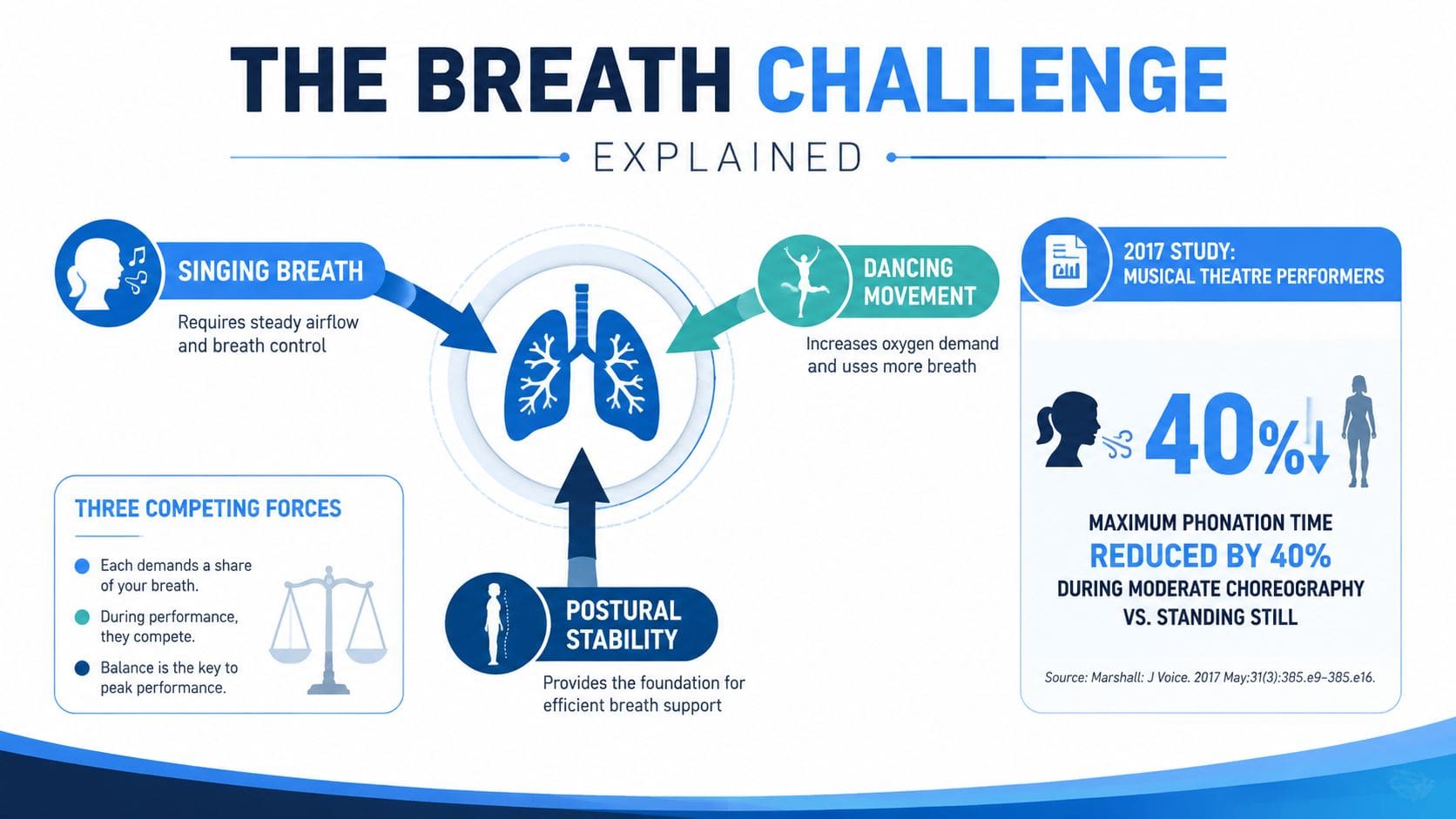
Singing and dancing place different demands on the same body. Singing requires controlled airflow, stable pressure, and precise timing. Dancing requires rapid changes in balance, muscle recruitment, direction, and posture. When they happen together, your body must keep the vocal instrument organized while movement constantly changes the conditions around it.
A 2017 controlled study of musical theatre performers found that maximum phonation time fell by 65.2%, from a mean of 20.4 seconds at rest to 7.1 seconds while singing and dancing (PubMed study). The study also found that tidal volume stayed constant across singing-only and dancing-only tasks, while minute volume fell by 16%. Relative oxygen uptake stayed unchanged even as heart rate increased.
That combination matters. The problem isn't just that you need to “work harder” or inhale more often. You need to coordinate airflow, phrasing, posture, and movement under time pressure. A long phrase that feels comfortable while standing can become poorly timed once your legs and torso are also managing choreography.
Why generic breath advice falls short
Many basic singing guides teach breath support as though the singer's torso remains stable. That advice can help with foundational technique, but it doesn't answer practical questions such as where to breathe after a jump, how to sing during a crouch, or how to maintain a microphone position while traveling across a stage.
A 2025 cross-disciplinary review of 74 studies concluded that physical and vocal demands become significantly more complex when singing and dancing occur together (University of Lancashire review). It identified training needs across athletic conditioning, vocal health, and choreography design. The review also highlighted the problem of siloed training, where performers prepare voice and movement separately even though integration determines the result.
Use a clear breathing resource, such as Encore Academy for the Performing Arts' guide to breathing properly while singing, for foundational mechanics. Then test those mechanics during movement. A breath that works beautifully in stillness isn't automatically useful on stage.
Building Breath Control and Posture Fundamentals
Begin with quiet, low breathing rather than dramatic inhalations. Stand with your feet balanced, release the knees, and let the ribs expand without lifting the shoulders. Inhale through the nose or mouth, then release a controlled “sss” while keeping the neck, jaw, and upper chest relaxed.
The goal isn't to hold air as long as possible. The goal is to control the release while your body remains available for movement. Practice the same exercise while shifting weight, walking slowly, and bending the knees. If the sound becomes uneven, reduce the movement before adding intensity again.
Build a stable performance frame
Good posture for a dancing singer isn't rigid military alignment. You need a responsive frame that can absorb movement without collapsing the ribs or locking the knees.
Use these checkpoints:
- Feet: Keep your weight distributed through the whole foot, especially during turns and direction changes.
- Knees: Maintain spring rather than locking them, because locked knees transfer shock upward.
- Pelvis: Let the pelvis stay neutral enough for the ribs to expand freely. Avoid gripping the glutes during every step.
- Ribs: Allow expansion in the sides and back, then release air without forcing the chest downward.
- Head and neck: Keep the head balanced above the spine. Reaching the chin toward the microphone often tightens the throat.
- Jaw and tongue: Check them after difficult movement passages. Unconscious clenching can make diction and resonance less flexible.
A useful supplemental explanation of trunk stability and alignment appears in PosturaZen's core posture guide. Apply the ideas dynamically, not by freezing the torso. Your posture should support the voice while allowing the choreography to remain expressive.
A physiological comparison found that singing and dancing together produced significantly lower breathing frequency and higher lactate than dancing alone, while VO2 and heart rate didn't differ significantly (physiological comparison). That result supports a practical training choice: don't judge readiness only by how fast your heart is beating. Pay attention to whether you can recover your breath and keep the voice coordinated between phrases.
Warm up with a clear purpose
| Exercise | Duration | Focus | Best For |
|---|---|---|---|
| Silent rib expansion | Brief repeated cycles | Low, quiet inhalation | Learning to inhale without shoulder tension |
| Controlled “sss” release | Several comfortable repetitions | Airflow consistency | Connecting breath management to sustained phrases |
| Gentle walking with humming | A short passage of easy movement | Voice and foot coordination | Preparing for low-intensity choreography |
| Step-and-speak phrases | Short lyric fragments | Diction under movement | Testing timing before full singing |
| Light choreography with a simple melody | A manageable section of the song | Integrated recovery | Identifying where phrasing needs adjustment |
Stop or simplify any exercise that creates throat pain, dizziness, or persistent vocal roughness. Conditioning should make coordination easier, not encourage you to push through warning signs.
Integrating Choreography with Your Voice
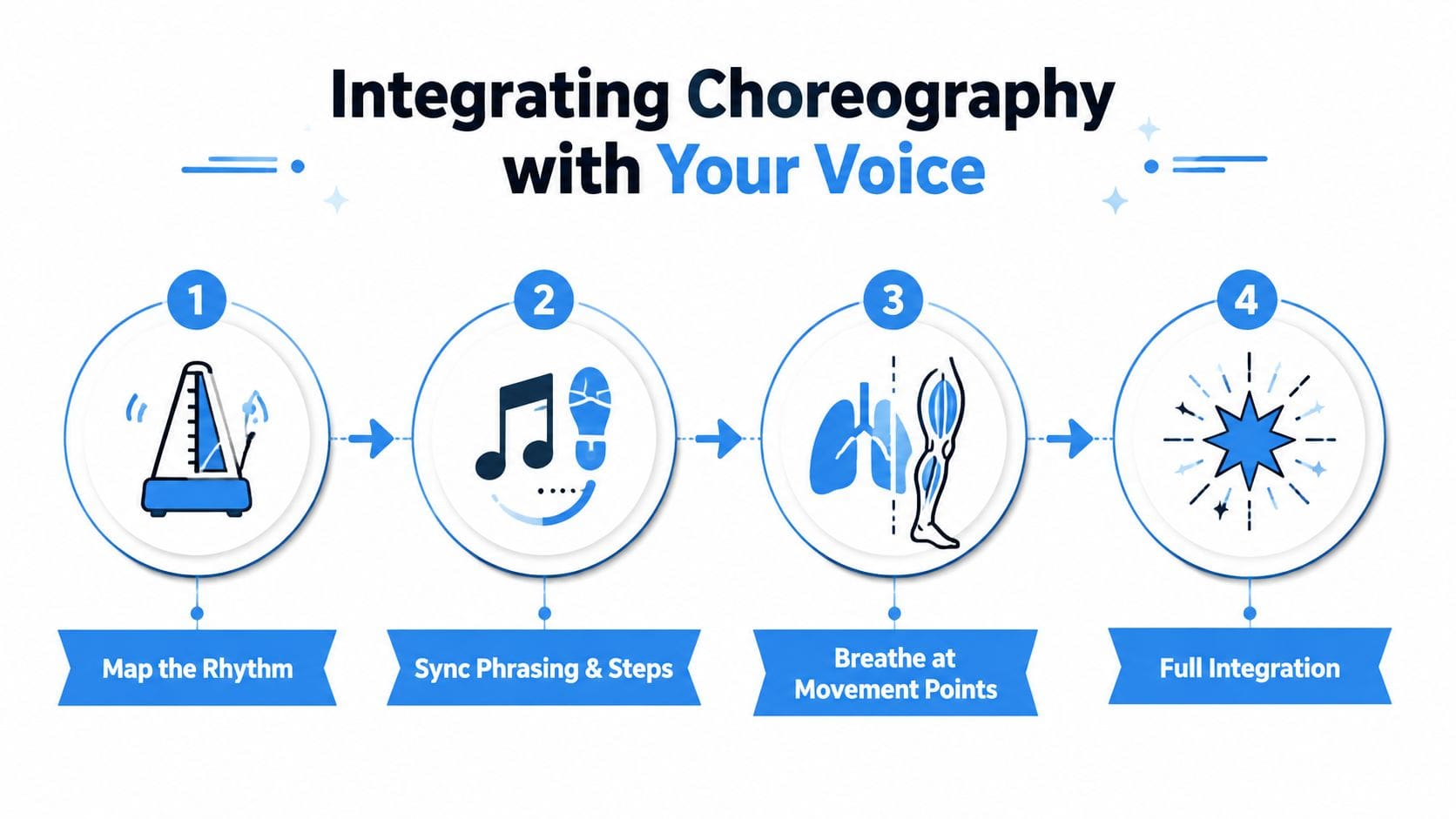
A live set can unravel when a strong dance phrase steals the breath needed for the next lyric. Build the song and choreography as one performance map. Mark the musical pulse, note which steps hit strong beats, then identify every practical breath opportunity, including quick releases between words. Add larger gestures only after those choices are clear.
Follow the integration sequence
- Map the rhythm. Speak the lyrics while tapping the beat. Listen for natural alignment among consonants, breaths, and footfalls.
- Sync phrasing and steps. Walk the choreography while speaking the text. If a step repeatedly disrupts a key word, shift its timing or make it smaller.
- Breathe at movement points. Use transitions, direction changes, arm releases, and visual stillness as planned breath opportunities. Recover before the air becomes urgent.
- Reach full integration. Add the melody, then raise movement intensity in stages. Keep the vocal line reliable before increasing performance size.
Visual intensity and physical strain do not have to rise together. A sharp head turn, precise hand gesture, or deliberate pause can communicate strongly while using less air than repeated jumps or oversized traveling steps. Reserve demanding movement for phrases that allow vocal recovery.
Microphone handling belongs in the choreography plan. Keep the angle consistent, avoid covering the grille, and rehearse distance changes for quiet and powerful phrases. Pulling the microphone away during a turn can make the sound vanish. Holding it too close during a high-intensity phrase can overload the vocal signal.
Performers developing theatrical movement can study Danza Academy of Social Dance's musical theatre dance resource for context on character, rhythm, and stage behavior. A practical rehearsal check is a karaoke night at The Banana Factory, where performers must manage a microphone while communicating with a room.
Practice Drills for Real-World Performance
Practice should reveal coordination problems before a live set does. Begin with the vocal line, then add movement in controlled layers. Running the full routine at maximum effort may show that something failed, but it will not identify whether breath timing, posture, phrasing, footwork, or microphone handling caused the problem.
Use progressive drills
Drill one, speak and step. Speak the lyrics in rhythm while walking the choreography. Keep the voice conversational so the body learns the timing. This exposes collisions between consonants and footfalls without adding pitch or vocal pressure.
Drill two, hum through transitions. Hum the melody through the hardest movement passages. Humming keeps the musical line active while reducing the urge to force volume. Notice whether the breath arrives before the movement demands it or only afterward.
Drill three, sing with reduced movement size. Perform the melody with restrained choreography. Preserve the timing, direction, and posture, while making gestures smaller. Expand the movement only after the vocal line stays dependable.
Drill four, isolate recovery points. Repeat the entrance immediately after a turn, jump, floor transition, or fast travel phrase. Practice the breath before the entrance, the first consonant, and the release of the line as one coordinated action.
Drill five, rehearse venue conditions. Use the actual microphone style whenever possible. Practice looking away from your feet, handling audience interaction, and continuing after a missed step. A clean studio run does not prepare you for a live room if the environment pulls your attention elsewhere.
Record a short section instead of relying on memory. Listen for rushed lyrics, swallowed consonants, unstable pitch, and changes in microphone distance. Watch the video with the sound muted, then listen without watching. The first review shows physical coordination; the second exposes vocal and microphone problems.
Performance note: If you cannot repeat a section cleanly at reduced intensity, adding effort will not solve it.
Use this video demonstration as another movement reference while comparing your own coordination. Do not copy the routine mechanically. Study the performer's preparation, weight transfer, and recovery between actions, then adapt those choices to your song and venue.
Avoid habits that create instability
- Holding your breath during effort: Exhale through the movement instead of bracing the entire torso.
- Making every gesture full size: Save large actions for moments that support the song and leave room for vocal recovery.
- Practicing only from the beginning: Start with difficult entrances and recovery points, not only the opening.
- Ignoring the microphone: Rehearse vocal distance, angle, and hand position as part of the choreography.
- Pushing through hoarseness: Reduce intensity and seek qualified vocal guidance if roughness continues.
A useful schedule rotates the focus. One session can address breath and posture, another spoken choreography, and another complete runs with video review. After demanding rehearsals, schedule lighter vocal work and keep audience-focused practice separate from maximum-intensity conditioning. That separation helps performers build athletic capacity, vocal reliability, and stage awareness without treating every rehearsal like a full show.
Performing with Confidence Under Pressure
Performance anxiety can change the voice before you sing a note. A 2026 phenomenology study of musical-theatre performers found that singing while dancing can trigger anxiety that negatively affects the voice, and it identified meaningful differences in breathing patterns between singers and dancers (2026 phenomenology study). Preparation must therefore include emotional regulation, not only physical repetition.
Use the same short pre-performance sequence every time. Check the floor, test the microphone, release the jaw, breathe easily, and speak the first lyric in rhythm. Familiar actions give your attention somewhere useful to go.
If you miss a step, keep the musical pulse and return at the next clear landmark. If a breath disappears, shorten the next phrase rather than forcing a strained entrance. Audience members usually respond more to your recovery and presence than to a small technical mistake.
A guide to karaoke night can help new performers understand the social side of live singing, but confidence comes from specific preparation. You don't need to look effortless in rehearsal. You need a repeatable method for staying musical while your body works hard.
The Banana Factory offers karaoke, sing-along programming, dancing, live entertainment, and a full bar and grill in Puerto Vallarta's Zona Romántica, giving performers and guests a practical setting for building microphone confidence and stage awareness. Visit The Banana Factory to check the current events and plan your next performance night.
