


You've just arrived in Puerto Vallarta, it's Saturday night, and every doorway in the Zona Romántica seems to promise a different version of the evening. One room is filling with dancers, another is advertising a drag show, and somewhere nearby a host is calling guests toward bingo. The difficult part isn't finding a gay bar event. It's knowing which night will feel welcoming, energetic, social, or too much for the mood you brought with you.
A strong LGBTQ venue doesn't leave that experience to chance. Its calendar gives the room a rhythm, teaches guests when to return, and turns one address into several distinct social experiences. The best programming supports revenue, but it also helps people find familiar faces, discover performers, eat, stay longer, and feel that they belong. This is how to read gay bar events as both entertainment and community infrastructure.
Table of Contents
- Stepping Into a Gay Bar Event for the First Time
- How Gay Bars Became Programming-First Spaces
- The Core Event Formats You Will Find
- A Week Inside a Zona Romántica Bar Calendar
- Programming Tips That Keep Events Recurring
- Safety, Consent, and Getting Home After the Show
- Matching the Right Event to Your Night
- Why Gay Bar Events Matter Beyond a Single Night Out
Stepping Into a Gay Bar Event for the First Time
The doorman recognizes someone before they reach the entrance. A bartender waves to a regular across the room. The host checks the microphone, a performer waits near the stage, and staff move chairs, glasses, and bodies into position for the next part of the night. In a well-run Puerto Vallarta venue, that choreography makes a busy Saturday feel less like a tourist stop and more like a room with a memory.

Read the room before choosing your place
Start by identifying the night's format. A drag show usually creates a performance-facing room, while karaoke leaves more space for participation and conversation. A dance party changes the function of nearly every table, so arriving early matters if you want a seat rather than a place in the crowd.
Then check the practical details:
- Arrival time: Early guests can settle in before the room changes shape.
- Performer lineup: A named host or featured act often signals a more structured evening.
- Dress expectations: Costumes, themed clothing, or a polished look may be encouraged, even when they aren't mandatory.
- Food availability: A kitchen can make a long event easier, especially when leaving would mean losing your group's place.
- Payment and entry rules: Ask about covers, minimums, and whether reservations apply to the event or only to tables.
Your first visit doesn't require expert knowledge. Watch how staff communicate, notice whether guests are invited into the activity, and ask a bartender where newcomers usually stand or sit. The venue's gay bar etiquette guide for first-timers can help you arrive with a better sense of personal space, tipping, photographs, and respectful participation.
Practical rule: Choose the event by the experience you want, not only by the name on the poster.
A recurring event also gives you an easy social opening. You can ask what happens next, compliment a performer, join a game, or return the following week knowing the format. That repeatability is the feature. The room becomes familiar because the programming gives people a reason to meet there again.
How Gay Bars Became Programming-First Spaces
Gay bars have long been more than places to purchase drinks. Under legal and social repression, they provided privacy, dancing, information, flirtation, friendship, and a visible point of contact for people who couldn't always find acceptance elsewhere. Historical accounts trace early examples to Europe in the late nineteenth and early twentieth centuries, including Zanzibar in Cannes, founded in 1885, San Francisco's Black Cat Bar, founded in 1906, and England's Cave of the Golden Calf, founded in 1912. These examples are documented in historical research on gay bars and LGBTQ venues.
The modern operator inherits that responsibility in a more competitive environment. Research using bar listings found that gay bars in the United States fell from 1,234 in 2012 to 730 in 2021, a decline of about 40%, while another period in the same research line recorded a 41% decline between 2002 and 2019. The contraction began before the pandemic and reflects longer-term pressures, including gentrification, changing social habits, and online dating. The same source recorded a rise from 730 venues in spring 2021 to 803 in 2023, alongside a shift away from rooms serving mostly or only cisgender men. That pattern suggests diversification, not a simple return to an older bar model.
The room now has to perform several jobs
When permanent venues disappear, recurring events carry more of the community's social load. LGBTQ nightlife research describes a shift toward club nights and episodic events, which means a surviving bar can't rely only on walk-in traffic. It has to create reliable occasions that bring people together repeatedly.
That's why bingo, karaoke, drag, themed dance nights, and live performances function as retention systems. Each one gives a guest a reason to return on a particular day and tells a promoter which audience the room is serving. A quiet bar can become a game room on one night, a performance venue on another, and a dance floor after dark.

The examples of successful gay bar theme nights follow this logic. A theme works when it produces a recognizable ritual, not merely a decorative poster. Operators need to balance production cost, staff workload, performer quality, and the spending behavior of the audience. Entertainment that creates no repeat habit is expensive noise. Entertainment that trains guests to return becomes infrastructure.
The Core Event Formats You Will Find
Most gay bar calendars rely on five formats, each solving a different operational problem. The right event for a guest depends on whether they want participation, spectacle, conversation, dancing, or a predictable social anchor.
| Event Format | Primary Goal | Typical Night | Cover Charge |
|---|---|---|---|
| Weekly community night | Retention and weekday footfall | Early or midweek | Often none or low |
| Themed party | Acquisition and visual differentiation | Friday or Saturday | Possible |
| Live show | Ticket yield and dwell time | Weekend or marquee date | Common |
| Karaoke | Participation and midweek activity | Weeknight | Usually none |
| Dance night | High-energy atmosphere and broad reach | Late weekend | Possible |
Weekly community nights
Trivia, bingo, and other games create a reason to arrive before the late-night rush. They work because guests can participate without needing a stage-ready talent or a large group. For operators, the important output is habit formation. Once guests associate a particular evening with a familiar host and predictable activity, the calendar starts doing some of the marketing work.
Trivia can also support food sales because participants tend to remain in place while rounds continue. The practical details behind what trivia night is matter more than a clever name. A host needs clear rules, a reliable microphone, visible scoring, and enough pauses for service.
Themed parties and live shows
Themed parties attract guests who want a reason to dress up and photograph the night. Their strength is acquisition, but they can become repetitive if the theme changes only in the artwork. Rotating music, hosts, performers, and visual cues keeps the concept legible without making it stale.
Drag, cabaret, and live vocal shows provide a stronger reason to charge admission because the guest is buying a scheduled performance. They also create a clear beginning, middle, and end, which helps the bar manage seating, service, and late-night conversion.
Karaoke and dance nights
Karaoke lowers the barrier to participation. It fills a room with amateur performers, reactions, and conversation, but it needs firm hosting so a small group doesn't monopolize the microphone. Dance nights do the opposite. They reduce the importance of seating and turn the room into one shared experience, so sound, lighting, crowd flow, and security need to work together.
A Week Inside a Zona Romántica Bar Calendar
A useful Zona Romántica calendar doesn't ask every night to behave like Saturday. It assigns each day a job, then builds staffing and promotion around that job.
Monday may begin with a relaxed trivia format or a karaoke warm-up. The objective isn't spectacle. It's to give residents, hospitality workers, and early-week visitors a low-pressure reason to leave home. Wednesday drag bingo addresses the midweek gap by combining a host-led show with an activity that encourages tables to stay engaged.
Thursday can carry a Latin music identity that brings together local guests and Spanish-speaking tourists. Friday works well for rotating DJ residencies because the format can change without forcing the venue to rebuild the entire production each week. Saturday carries the marquee show, with featured performers and a stronger promotional push. Sunday often shifts into brunch, an afternoon show, or a gentler drawdown that keeps the venue useful after the biggest late-night crowd has gone.
The day-by-day operating logic
Extended happy hour can anchor the early part of the evening, then the show can begin once guests have settled in. At The Banana Factory, the published schedule lists 2-for-1 on all drinks from 2:00 pm to 9:00 pm Monday through Thursday and from 11:00 am to 9:00 pm Friday through Sunday, with bar and grill service continuing until 4:00 am. Those are venue-specific operating details, not a universal template, but they show how food, drinks, and programming can keep guests in one place across multiple phases of a night.
| Day | Event Format | Peak Window | Programming Goal |
|---|---|---|---|
| Monday | Trivia or karaoke warm-up | Evening | Build a low-pressure weekly habit |
| Tuesday | Community game or casual social night | Evening | Support regulars and solo visitors |
| Wednesday | Drag bingo | Evening into late night | Fill the midweek gap |
| Thursday | Latin music night | Evening into late night | Reach locals and Spanish-speaking visitors |
| Friday | Rotating DJ residency | Late evening | Attract weekend groups |
| Saturday | Featured live show and dance | Late evening | Create the marquee occasion |
| Sunday | Brunch and show | Daytime into evening | Extend the weekend and encourage return visits |
Monthly events, such as an anniversary party or a last-Saturday theme, should occupy a known slot rather than appear randomly. Predictability lets guests plan around the event, while rotation gives regulars enough novelty to keep paying attention.
Programming Tips That Keep Events Recurring
A recurring event survives when the operator treats it as a product with a schedule, a team, and feedback. A poster can announce a night, but only consistent execution teaches people to return.
Build the habit first
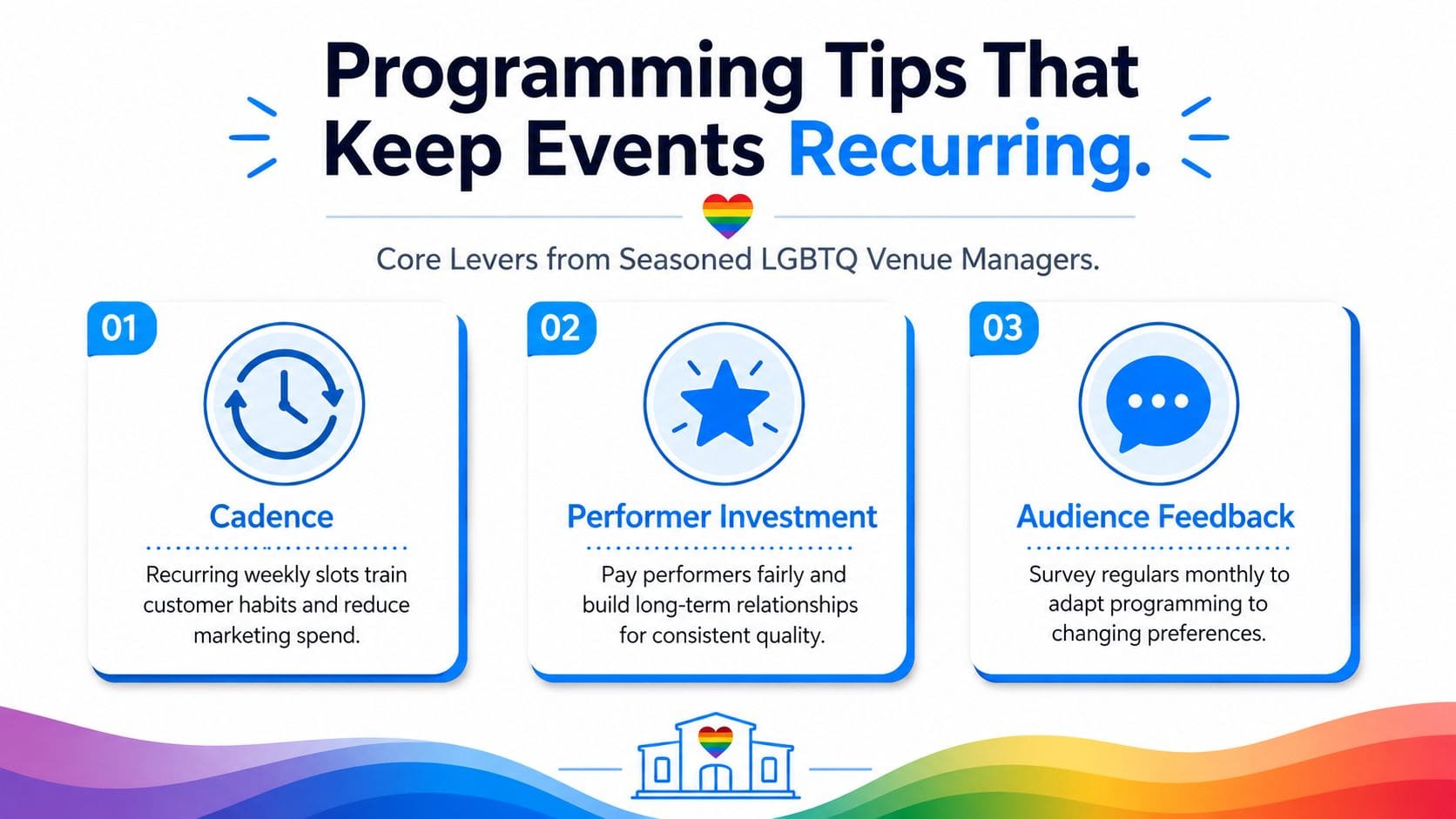
Cadence is the foundation. Put the event in the same weekly slot, keep the name recognizable, and avoid changing the start time without a strong reason. Guests should be able to recommend it from memory. A recurring night also gives staff a stable service pattern, which reduces the operational confusion that comes with constant reinvention.
Invest in people, not only concepts
A reliable performer network is more valuable than a long list of untested ideas. Drag artists, DJs, hosts, and dancers learn the room's pace, service constraints, and audience expectations. Pay them fairly, communicate call times clearly, and maintain relationships between bookings. That consistency reduces last-minute cancellations and gives guests a reason to trust the lineup.
The event still needs variation. Keep the core format stable, then rotate the sub-theme:
- Seasonal changes: Shift costumes, music, or visual details without abandoning the event identity.
- Guest hosts: Bring in a new personality for a special edition.
- Audience prompts: Let regulars vote on songs, categories, or themes.
- Intermission offers: Pair a performer's signature cocktail or a small-plate feature with the show break.
Food and drink pairing works best when it supports the event rather than interrupts it. A kitchen can release shareable plates before a show, serve quick items during intermission, and offer late-night food after dancing begins. Operators should compare cover income with bar and kitchen spend, then ask whether the event is building repeat attendance or merely producing one crowded night. A format that fills seats but leaves weak spending may need a service redesign. A quieter event with strong return behavior may deserve patience and better promotion.
Safety, Consent, and Getting Home After the Show
A friendly atmosphere isn't the same as a safe operating plan. LGBTQ nightlife research has identified serious consent concerns, including 21% of LGBTQ+ people reporting sexual assault in an LGBTQ+ venue and 61% reporting unwanted sexual or intimate touching in a social setting, while only 19% reported the assault to police. These figures come from recent reporting on safety in LGBTQ venues, and they should change how guests and operators evaluate “inclusive” branding.
Consent needs visible procedures
Staff should know when to interrupt harassment, how to separate people without escalating the situation, and where to take a guest who needs privacy. Guests should ask about photography rules before filming performers or strangers. Some venues restrict phone recording on dance floors because filming can expose people who expected a private night out.
Late-night promotions require the same care. Welcome drinks and shot specials can make service faster and louder, but bartenders still need to notice intoxication, coercion, and guests who have lost contact with their group. A sober friend, charged phone, and agreed meeting point are simple safeguards that don't diminish the event.
Plan the journey home before the music peaks
In Puerto Vallarta's Zona Romántica, discuss the pickup point before leaving the bar. Guests may use rideshare services or taxis, but a crowded street can make it difficult to identify the correct vehicle. Groups should stay together when possible, keep one person aware of the route, and avoid allowing an impaired guest to travel alone.
Look for practical signals inside the venue:
- Door security: Staff monitor entry and respond when someone is removed.
- Visible radios: Teams can communicate across a busy room.
- Well-lit exits: Guests can leave without searching through darkness.
- Accessible staff: Bartenders and hosts make it clear whom to approach.
- Crowd control: Furniture and queues don't create dangerous bottlenecks.
A 2025 survey report also found that nearly half of LGBTQIA+ respondents avoided LGBTQIA+ venues because of safety concerns, and rated traveling home on public transport at 2.8 out of 5, as described in the same safety coverage. A venue that communicates its procedures clearly gives people a more useful promise than an “all are welcome” slogan.
Matching the Right Event to Your Night
Selecting an event is easier if you decide what you need before opening social media. Use four filters: mood, group size, budget, and timing. Each one eliminates a poor match before you spend money, wait in line, or discover that the room's energy isn't what you wanted.

Start with mood
A relaxed night favors trivia, bingo, or an early drag show where conversation remains possible. A high-energy night points toward a DJ residency or dance event. Don't assume a show automatically means dancing. Read the description for clues such as seated performance, guest host, live vocals, or late-night dance floor.
Group size changes the calculation. Solo travelers often do well at participatory events because the format provides a natural introduction. A large bachelor group may prefer a high-capacity dance night, but should check table availability and entry policies before arriving. Smaller groups can choose between a social game and a performance depending on whether they want interaction or observation.
Match spending and curfew
Budget isn't only the cover charge. Consider drinks, food, table requirements, transport, and how long you expect to stay. A happy-hour arrival can make a long evening more manageable, while a late show may suit guests who want to avoid paying for hours they won't use.
Timing also signals the audience. Early events often attract regulars and diners. Late dance programming can skew toward visitors, larger groups, and guests seeking peak energy. The local and tourist mix changes by season and by theme, so check recent posts rather than relying on a permanent description.
Before leaving your hotel or home, run this quick check:
- Mood: Do you want conversation, participation, performance, or dancing?
- Group: Will the format help a solo guest, a couple, or a large party?
- Budget: What can you spend on entry, drinks, food, and transport?
- Timing: Do you want to leave near midnight or continue until late?
Then confirm the performer lineup, start time, dress guidance, and any last-minute format change. A little preparation turns the night from a random door choice into a deliberate experience.
Why Gay Bar Events Matter Beyond a Single Night Out
A calendar of gay bar events is easy to mistake for an inventory of entertainment. From the operator's side, it's closer to a neighborhood map. Each recurring night tells people where to find one another, when a particular crowd gathers, and what kind of interaction the venue supports.
That role matters because the permanent venue landscape has contracted. A London study found LGBTQI venues declined from 125 in 2006 to 53 in 2017, a net loss of 58%, while also documenting how event ecosystems continued even as venue counts fell in research on LGBTQ cultural infrastructure. In the United States, the research cited earlier shows a long decline followed by a partial rebound and a more diverse mix of venues. The lesson is not that events replace every function of a permanent space. It's that programming can preserve connection when fewer physical rooms carry more demand.
Repetition creates belonging
Weekly bingo can give a quiet night a dependable center. Karaoke lets newcomers participate without needing an introduction. A themed Saturday creates a return-visit reason for travelers and locals, while a live show keeps performers, staff, and audiences connected to the same address. A full kitchen and late service add another layer, allowing guests to eat, watch, talk, and continue dancing without breaking the group apart.
This is also why event quality affects venue survival. LGBTQ nightlife studies describe event programming as a substitute infrastructure, with operators needing to manage cadence, repeat attendance, community signaling, and audience feedback. The venue becomes a multi-format social platform, not merely a room that sells drinks.
The wider demand is mobile as well as local. Independent LGBTQ venue coverage reported that 46.3% of surveyed respondents said there were fewer LGBTQIA+ venues in their area than three years earlier, while a 2026 report from Time Out and Gay Times found 74% of respondents attended queer nightlife at least monthly and 90% were willing to travel for the right space, music, and crowd. Those findings are reported in coverage of the challenges facing independent LGBTQIA+ venues. They reinforce a practical point for Puerto Vallarta: a dependable calendar can motivate travel, serve residents, and distinguish one venue from another.
When a host starts bingo, a DJ takes the booth, or a performer walks onstage, the event does more than fill a schedule. It maintains a network. Protecting that network requires thoughtful programming, trained staff, fair performer relationships, consent procedures, and enough consistency for people to trust the room.
The Banana Factory combines recurring gay bar events with a full bar, The Grill by BF, late-night service until 4:00 am, extended 2-for-1 happy hours, weekly Saturday bingo, periodic live shows, karaoke, dancing, and Cowboy Night on the last Saturday of each month. Plan your next evening around the format that fits your group, then visit The Banana Factory in Puerto Vallarta's Zona Romántica for food, drinks, and a dependable place to gather.
