

Trivia night is a hosted quiz competition at a bar, pub, restaurant, or community venue. Sessions commonly last 90–120 minutes, using several question rounds to give people a reason to meet, order drinks, and return, particularly during quieter midweek hours.
The format works like a social game show, with a host guiding the room rather than just reading random questions into a microphone. A well-run event brings together team play, varied categories, visible scoring, social breaks, and a clear finish. Players discuss answers and share the suspense of each reveal. Venue owners gain a scheduled occasion that concentrates demand within a defined evening time slot.
Technology can remain simple or become part of the experience. A modern event may use printed answer sheets, a projector, a smartphone buzzer system, or all three. Questions can cover music, films, history, science, sports, local knowledge, or a theme selected for the audience.
The winning team usually receives a prize. Attendance also grows from the shared ritual: debating uncertain answers, celebrating correct guesses, and meeting familiar faces each week. That combination makes trivia night a drinks-led social format with a clear start, finish, and reason to stay.
Table of Contents
- The Core Concept Behind Trivia Night
- From British Pubs to Global Nightlife Staple
- How a Typical Trivia Night Works
- The Data Behind When and Why Trivia Nights Succeed
- Joining Your First Trivia Night as a Player
- Running Trivia Nights That Keep Teams Coming Back
- How Technology and Themes Are Reshaping the Format
The Core Concept Behind Trivia Night
At its simplest, trivia night is a hosted quiz in which teams answer questions across several categories and compete for the highest score. The host reads or displays each question, gives teams time to discuss their answer, collects responses, and announces results as the game progresses. That structure turns individual knowledge into a group activity.
A useful comparison is a game show brought into a social venue. Players don't sit taking a test. They debate whether a song was released in one decade or another, combine someone's knowledge of geography with someone else's film memory, and enjoy the tension before the host reveals the answer. The questions create the activity, but the conversation creates much of the atmosphere.
Practical rule: A trivia night should reward teamwork, not just the person who knows the most facts.
The team format also makes the event accessible to beginners. Someone may struggle with sports but excel at music, food, languages, or local history. The host can support that variety through themed rounds and mixed difficulty, so teams have repeated opportunities to contribute rather than relying on one specialist.

Why venues use the format
For a venue, trivia night is both entertainment and event programming. A regular quiz gives customers a reason to choose one location over another on a particular evening. It also creates a predictable rhythm, because teams who enjoy the experience can return for the next event and bring friends.
The event works best when the venue treats the quiz as part of the complete visit. Clear audio helps every team hear the questions. Tables need enough space for discussion and writing. Staff should understand when rounds begin, when teams can order, and when score updates or breaks occur.
The result isn't “people answering questions at a bar.” It's a repeatable social product with a host, a schedule, rules, refreshments, and a competitive conclusion. That combination explains why trivia night has remained adaptable across pubs, restaurants, libraries, community spaces, and nightlife venues.
From British Pubs to Global Nightlife Staple
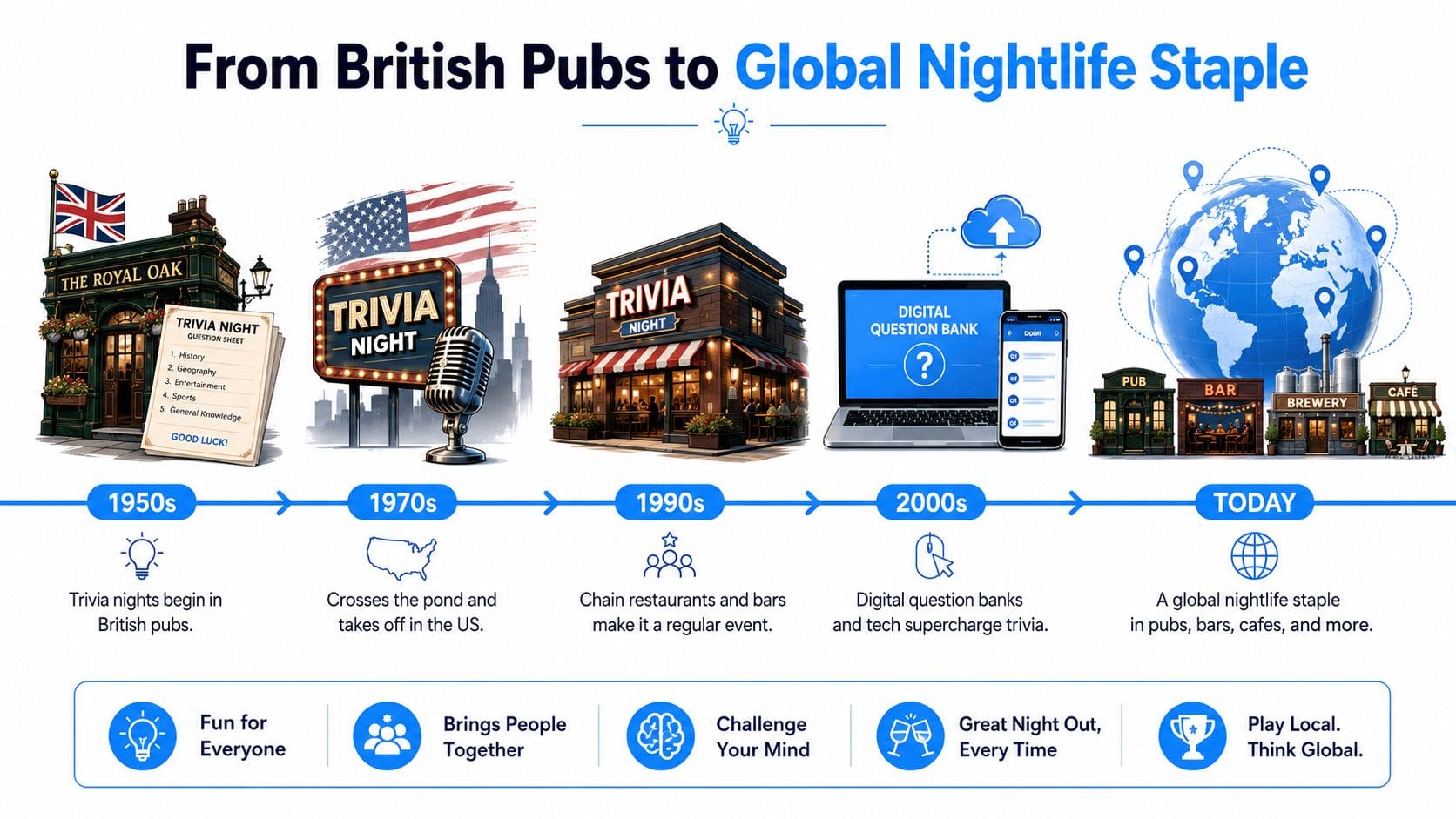
Trivia night grew from British pub quiz culture, where local groups gathered for organized question-and-answer competitions. Early organized activity was documented in the late 1950s in Merseyside and Lancashire, with about 4,000 people involved in quiz leagues that spread from Bootle to Southport, according to the history of the pub quiz.
The format gained a more formal shape in 1976, when Sharon Burns and Tom Porter launched 32 quiz teams across three leagues in southern England. Their model had a practical business purpose. It was designed to draw customers on quieter nights, turning a pub's slower period into a recurring occasion rather than leaving the venue dependent on peak weekend demand.
Why the old structure still matters
Print references appeared by 1959, and British popularization expanded during the 1970s, showing how the activity moved from a local pastime toward a repeatable nightlife program. League-style organization helped establish conventions that still feel familiar today, including recurring events, team standings, rounds, answer sheets, and prize announcements.
The model also demonstrated that a quiz could scale beyond one pub. One historical account reports that Burns and Porter's weekly quiz grew from 30 teams to 10,000 teams over time, according to the trivia-night data overview. That growth illustrates the commercial strength of a format that can be reproduced while still allowing each host to adjust categories, tone, and difficulty for a local audience.
The concept later traveled into other markets and venue types. Bars and restaurants adopted it as a regular attraction, while community organizations used it to bring people together around shared interests. Modern hosts may add music clips, visual questions, themed prizes, or digital scoring, but the underlying formula remains recognizable: gather teams, ask questions, reveal answers, track points, and celebrate the final result.
Trivia night became global because it doesn't require an elaborate stage or a specialized facility. It needs a host who can manage the room, a question set that respects the audience, and a venue willing to give the event a reliable place on its calendar.
How a Typical Trivia Night Works
A first visit feels easier once the sequence is clear. Events at established venues typically follow a recognizable pattern, although hosts may adjust the number of rounds, question formats, prizes, and breaks. For a venue owner, that structure also creates a dependable evening schedule around which food, drinks, staffing, and table service can be organized.
Before the first question
Players arrive, order drinks or food, then join a prearranged group or form a team at the venue. Teams commonly include four to six people, which allows varied knowledge while keeping discussion manageable. The host explains how answers are submitted, whether phones are prohibited during questions, and how ties or disputes will be handled.
The opening round sets the tone. It may cover general knowledge or introduce the evening's theme. A skilled host starts with accessible questions, then adds harder prompts so new teams can participate before the competition becomes more intense.
Through the rounds
A typical event uses several rounds instead of one long list of questions. Categories may include pop culture, history, science, music, sport, food, geography, or local knowledge. The guidance on trivia-night structure and engagement recommends a 90–120 minute format with multiple rounds, mixed difficulty, and immediate feedback through scorekeeping, buzzers, or visible leaderboards.
Between rounds, the host or scoring team updates the standings. This feedback loop keeps teams attentive. A group that began poorly can still recover, while a leading team has to watch competitors close behind.

A themed or bonus round can change the room's energy. The host might play a recognizable song, display an image, or ask questions connected to a film series. These rounds give specialists a chance to contribute, even if they are less confident with general knowledge.
The event usually includes a short intermission or ordering pause. Players can socialize, staff can serve tables, and the host can prepare the next segment without rushing. This pause also supports trivia night's drinks-led happy-hour role, keeping customers engaged with the venue rather than treating the quiz as a separate stage show.
The final rounds generally use the same scoring system. After the last answers, the host updates the leaderboard, runs a tie-breaker if necessary, and announces the prizes. For a related example of a hosted social competition with a performance element, see what karaoke night involves.
A good host keeps explanations brief, repeats important rules, and maintains momentum without making players feel hurried. The goal is a social contest that gives every team time to think, discuss, laugh, order, and stay interested through the final answer.
The Data Behind When and Why Trivia Nights Succeed
Trivia night works as a time-slot-sensitive venue event, not a generic bar activity that performs equally well every evening. Venue-discovery data lists Tuesday as the biggest trivia night in one dataset, with 3,025 events. The same comparison lists 6,560 events at 7:00 PM, compared with 1,717 at 6:00 PM and 1,250 at 8:00 PM. The pattern points to a concentrated early-evening window, although each venue still needs to compare these benchmarks with its own traffic.
| Metric | Value | Insight |
|---|---|---|
| Largest listed trivia night | Tuesday, 3,025 events | Midweek scheduling is central to the format |
| Most common listed start time | 7:00 PM, 6,560 events | Early evening creates the clearest concentration |
| Other listed start times | 6:00 PM, 1,717 events; 8:00 PM, 1,250 events | The event window matters, not just the day |
The format also has an established international presence. The same dataset reports 22,445 weekly trivia events in the UK versus about 2,000 in the U.S., and estimates that the UK has 55.7 times as many trivia nights per capita. These figures are context rather than a forecast for any individual venue, but they show that trivia has developed beyond occasional bar entertainment.
A drinks-led occasion
The ordering context helps explain why the time slot matters. On-premise data describes trivia as over-indexing at happy hour by 134% and at game night by 1,096%, while under-indexing at dinner by 68%, according to on-premise trivia insights. In practice, trivia resembles a scheduled drinks occasion with food supporting the visit, rather than a standard dinner booking.
The same source says trivia drinkers tend toward playful, nostalgic cocktails instead of premium or coffee-forward options. A venue can match that preference with a clear happy-hour drink specials menu, quick-to-serve beverages, shareable food, and table service that keeps orders moving between rounds.
Scheduling insight: Choose the time slot first, then build the quiz and offer around how guests use that period.
Attendance becomes more useful when operators compare it with sales and repeat behavior. data-driven restaurant strategies can help evaluate ordering patterns, busy periods, return visits, and menu performance. That analysis shows whether trivia is filling a quiet early-evening period, extending customer stays, or shifting existing traffic into a different format.
Joining Your First Trivia Night as a Player
Your first trivia night doesn't require a specialist memory or a team of encyclopedias. The strongest group usually combines different interests, because one person may know music while another handles geography, films, food, or science.
Start by checking the venue's website, social channels, event calendar, or local event listings. Some hosts ask teams to reserve a table, while others allow walk-ins and let solo players join a group at the venue. If the event is popular, contacting the venue in advance can prevent an avoidable seating problem.
Build a useful team
Choose collaborators who enjoy discussing answers, not just people who claim to know everything. A balanced team might include:
- A culture specialist: Useful for music, television, film, celebrities, and internet culture.
- A practical generalist: Often strong at food, places, everyday science, and common knowledge.
- A detail-focused thinker: Helpful for wording, dates, patterns, and questions with carefully limited clues.
- A calm decision-maker: Keeps the group from changing a sound answer because someone becomes nervous.
You don't need every role, and you shouldn't treat the quiz like a workplace assignment. The point is to make a collective decision, accept that some answers will be guesses, and enjoy the debate.
Arrive early enough to find a comfortable table and understand the ordering process. Bring a pen if the venue uses paper answer sheets, but don't worry about special equipment. A lucky charm is welcome, although it won't replace listening carefully to the host.
Play for the room, not only the score
Ask about phone rules before the first round. Most events expect teams to discuss answers without searching, and following that rule protects the friendly competition. Pay attention to the host's wording, write answers clearly, and keep a running conversation rather than waiting for one person to solve every question.
If a category isn't your strength, use it as a chance to contribute indirectly. You might recognize a voice, identify a broad era, notice a clue in the wording, or help the group reject an unlikely answer. Trivia night works because individual gaps become less important when people think together.
Order during a break when possible, thank the host, and introduce yourself to nearby players if the atmosphere feels welcoming. Returning teams often become part of the event's social identity, but beginners don't have to win before they belong.
Running Trivia Nights That Keep Teams Coming Back
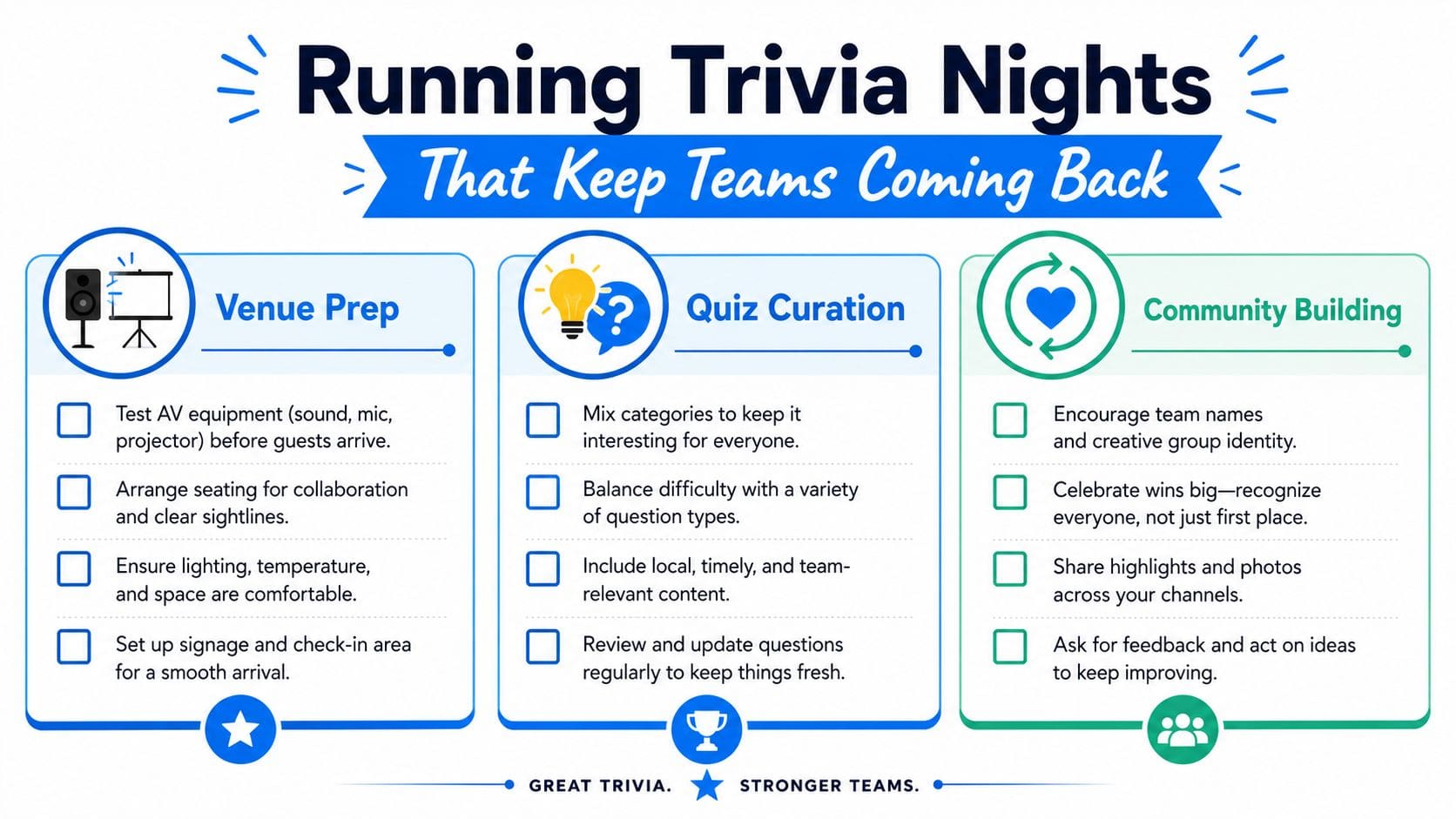
A dependable trivia night is built around timing and operations. Choose a consistent day, publish a clear start time, test the sound system, display the rules, and use scoring that players can follow. In a drinks-led happy-hour slot, delays affect both team energy and service flow, so the opening minutes should feel organized rather than improvised.
The hosting guidance on team participation and quiz logistics recommends preset rules, clear round structures, team formation, themed rounds, and varied categories. Together, these choices help staff manage the room while giving people with different interests a way to contribute.
Design the experience around return visits
Keep the quiz within a manageable 90–120 minute window, as recommended in the trivia-night engagement guidance. A long event can slow service and tire players, while a rushed one may not justify the visit. Use several rounds, alternate categories, and share score updates so teams can follow the competition without losing the social pace.
Question curation requires balance. Include approachable prompts, harder questions for experienced teams, and themed material that gives different guests a reason to join. Avoid making every answer obscure or automatic. A good quiz works like a mixed playlist, familiar enough to invite participation, varied enough to hold attention.
Visible standings and prompt answer reveals provide useful feedback. Players know where they stand, and the host can address confusion before it becomes an argument. If a question is ambiguous, explain the ruling calmly and apply the same standard to every team.
Make operations feel effortless
Test microphones and speakers before guests arrive. Keep answer collection simple, post prize rules where teams can see them, and assign scoring to another staff member if the host cannot handle both jobs comfortably. The host should keep rounds moving, adjust when service slows, and create energy without taking over the room.
Prizes can be modest: a rotating trophy, a food or drink reward, a themed item, or recognition for categories such as best team name. Consistency matters more than extravagance because players need to know what participation leads to.
Apply the same scheduling discipline to recurring games, including these bingo night ideas. Trivia becomes a dependable community appointment when the venue protects its time slot, prepares staff, and gives teams a clear reason to return.
How Technology and Themes Are Reshaping the Format
The paper-and-host version of trivia still works, but it no longer defines the whole category. Smartphone-based buzzer systems can increase participant engagement by up to 60%, and venue operators are using branded interfaces, offline-capable software, and rotating game-show formats to reduce friction and encourage repeat attendance, according to 2026 trivia show trend reporting.
The same reporting describes trivia events as up 403% year over year in 2026, a future-dated market snapshot that signals strong momentum rather than a guarantee for every venue. Technology can remove manual tallying, speed up answer collection, and support multimedia rounds with audio, video, and images.
Themes also make the format easier to refresh. A host might build an event around a pop-culture moment, a local community interest, a music era, or a venue identity. Rotating formats prevent regular teams from feeling that every week follows the same script, while branded screens and digital scoring can make the event feel more like a produced show.
The core remains human. Players still debate, laugh, and celebrate together. Technology works best when it supports that interaction instead of burying it behind complicated rules.
The Banana Factory offers a full bar, on-site grill, recurring community events, and extended happy-hour service in Puerto Vallarta's Zona Romántica, making it a natural place to enjoy a social game-night atmosphere. Visit The Banana Factory to check its current programming, drinks, food, and nightlife schedule.
